 {# Overlay logo in the middle of the banner, no layout shift #}






NWSL High Impact Player Rule





Today, the NWSL introduced the High Impact Player (HIP) Rule at a moment when the league’s long-standing economic assumptions no longer align with the reality it helped create. The rule is scheduled to go into effect on July 1, 2026.
At its core, the change allows clubs to spend beyond the traditional salary cap in order to recruit and retain elite talent that might otherwise choose, or remain in, Europe. It represents a formal acknowledgment that the league now operates within a global labor market, not a closed domestic one.
It is also important to note that the rule requires approval from the NWSL Players Association (NWSLPA).
Breakdown of the High Impact Player Rule
Under normal circumstances, each club operates under a strict salary cap. For 2026, that cap is projected to be approximately $3.5 million, covering a minimum 22-player roster.
Under the new rule, each team will be permitted up to $1,000,000 in additional salary spend that does not count against the base cap. That allowance will increase year-over-year at the same rate as the salary cap itself.
Clubs may allocate the full amount to a single player or distribute it across multiple qualifying players. However, this additional spending is restricted. Not every player is eligible, and the mechanism is designed to apply only to those deemed to have “high impact” under league-defined criteria.
The High Impact Player Rule marks the NWSL crossing a line it avoided for years: formally acknowledging that competitive balance alone cannot anchor a league operating in a global market.
“Ensuring our teams can compete for the best players in the world is critical to the continued growth of our league” NWSL Commissioner Jessica Berman

HIP Criteria
To qualify as a High Impact Player, an individual must meet at least one defined commercial or sporting benchmark, intended to ensure the mechanism is reserved for players with demonstrable on-field and off-field impact. Those critera are:
- Inclusion in SportsPro Media’s Top 150 Most Marketable Athletes within the prior year
- Top-30 placement in Ballon d’Or voting within the prior two seasons
- Selection in the Guardian Top 100 footballers within the prior two seasons
- Selection in ESPN FC’s Top 50 footballers within the prior two seasons
- Top-11 minutes played for the USWNT over the prior two calendar years (field players)
- Top-one minutes played for the USWNT over the prior two calendar years (goalkeepers)
- Selection as an NWSL MVP finalist within the prior two seasons
- Selection to the NWSL Best XI First Team within the prior two seasons
In addition, any player utilizing HIP funds must carry a cap charge equal to at least 12% of the team’s base salary cap, placing that threshold at roughly $420,000 in 2026.
The league has indicated that these criteria may evolve over time.
So who qualifies?
Abigail Segel has provided one of the clearest examinations of eligibility under the High Impact Player Rule.
Who exactly is eligible for HIP money?
In her research, Segel identified 99 players who currently qualify under the published criteria, along with a list of notable players who do not. The result underscores how narrowly the rule is constructed and how selectively it is intended to function.

NWSLPA reponse
The NWSL Players Association has formally opposed the High Impact Player Rule as currently structured.
The union’s position is not rooted in opposition to higher spending. It is rooted in how that spending is distributed. The NWSLPA argues that if the league has the financial capacity to allocate an additional $1 million per team, that money should be incorporated into the base salary cap rather than reserved for a narrowly defined class of players.
From the union’s perspective, the rule represents a step backward. After years of simplifying roster and compensation mechanisms, the HIP designation reintroduces categorical pay structures that prioritize retention optics over broad-based wage growth.
The NWSLPA has also pushed back on the league’s framing of the rule as necessary to remain competitive globally. While acknowledging the pressure created by European leagues, the union argues that raising the overall salary floor would better address player retention while improving compensation across the entire workforce.
In this framing, the High Impact Player Rule is less about market inevitability and more about strategic choice.
Trinity Rodman
Rodman sits at the intersection of every pressure point the NWSL is now managing: national team relevance, commercial value, international transfer interest, and long-term career trajectory.
She is not an exception. She is an early example of a profile the league increasingly produces.
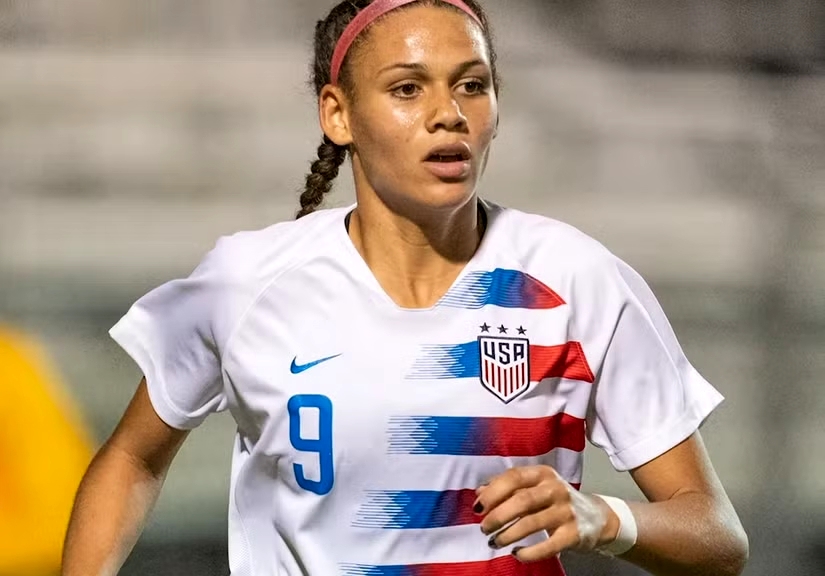
The previous NWSL model could accommodate one such player at a time. It cannot accommodate many of them simultaneously. The High Impact Player Rule is the league’s attempt to raise its economic ceiling through targeted retention rather than across-the-board wage growth.
That attempt is necessary. It is also incomplete.
Rodman may still leave. The rule does not prevent that. If she does, however, the mechanism does not fail.
A $1 million cap exception narrows the gap between the NWSL and Europe. It does not eliminate it. Losing a player after creating a retention mechanism is materially different from losing one because no such mechanism existed.
The league’s long-term credibility does not hinge on any single outcome. It hinges on whether future elite players see an institution willing to respond to their market value with structure rather than denial.
If Rodman leaves, the data point is not her departure. It is the league’s response to the conditions that made departure possible.
ATL NWSL VIPs NWSL
Rules